The short version
Three things to keep in mind.
- 01
Define the breeder’s size label.
- 02
Review parents and adult relatives.
- 03
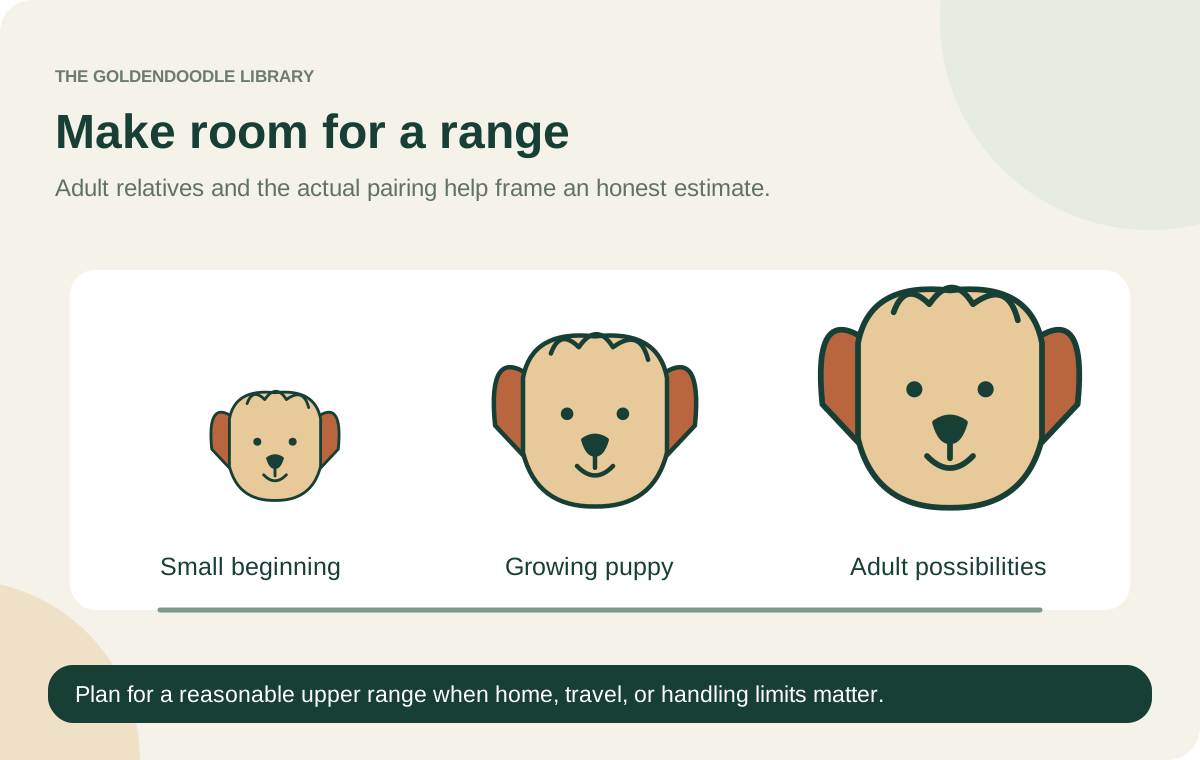
Plan for the upper end of a sensible range.
What to remember
Your useful takeaways.
- Poodle varieties have height definitions; Goldendoodle marketing size labels still need clarification.
- Adult relatives are more informative than a generation abbreviation alone.
- Size is genetically complex, so one ancestry percentage cannot determine adult weight.
- Plan for the upper end of a reasonable range when practical limits matter.
A little more detail
Explore the questions that matter to you.
Open a section when you want the why behind the short answer.
01Start by defining the label
The Poodle Club of America distinguishes Toy, Miniature, and Standard Poodles by shoulder height. Those parent-breed categories do not automatically provide a universal weight chart for Goldendoodles. If a breeder advertises a mini Goldendoodle, ask what adult height and weight range they mean.
Keep weight and height separate in your notes. A housing policy may specify weight, a vehicle setup may depend on body length, and a particular activity may involve different physical considerations. A single word such as medium cannot answer every practical question.
References: [1]
02Look beyond one parent’s size
Ask for the mature sizes of both parents and, where known, their close adult relatives. If the same pairing has produced earlier litters, information about those adult offspring may help the breeder explain the current estimate. A photograph without scale is much less useful than an actual adult measurement.
Record whether a number is a measured adult weight, an estimate, or a target. Do not quietly turn a hoped-for size into a confirmed fact. A puppy still growing is not an adult example, and an unusually small or large relative should not become the only reference point.
03Why percentages cannot settle the question
Canine size research identifies multiple relevant genes and pathways. Research into IGF1 and other body-size loci helps explain why ancestry labels do not operate like a simple adult-weight switch. A DNA trait report may add information, but it still needs to be interpreted within its stated limitations.
For a family choosing a companion, the important consequence is modest: do not use an ancestry calculation as a substitute for a careful size discussion. “More Poodle” does not say which Poodle family or variety is involved, and does not by itself tell you the adult size of an individual puppy.
References: [2]
04Plan for the dog your household could actually manage
List the real limits before choosing a puppy. Consider lifting needs, available help during illness, grooming transport, car access, stairs, household equipment, and any applicable written housing restrictions. Bring those details to the breeder instead of asking for the smallest puppy in a photograph.
If a small difference in size would make the placement impractical, say so clearly. Ask how much uncertainty remains and whether the timing or a different placement would suit your situation better. A future service-dog interest also deserves input from an appropriately qualified training professional; size alone cannot establish suitability for a task.
05What a useful estimate sounds like
A useful explanation describes a range, the evidence behind it, and the factors that could make the estimate wrong. It also distinguishes a breeding goal from a contractual guarantee. Ask the breeder to explain any written size terms rather than relying on what a headline seemed to imply.
When you go home, plan to monitor growth with your veterinarian and choose equipment for the dog in front of you. Avoid trying to keep a puppy within a promised size through inappropriate feeding or exercise. The long-term aim is a comfortable, healthy adult whose needs your family is prepared to meet.
Sources & further reading
References supporting this guide; inclusion does not imply endorsement of our program.
- Poodle Club of America: Sizes of Poodles ↗
- Plassais and colleagues: Body-size genetics in ancient and modern canids (2022) ↗
For an individual dog’s health or behavior, consult your veterinarian or qualified trainer. For access or funding questions, check current official guidance.
A personal next step
Talk it through with Blaine.
Ask about a planned pairing, puppy matching, or preparing for home.