The short version
Three things to keep in mind.
- 01
Ask why these two parents were paired.
- 02
Review records and placement terms before paying.
- 03
Discuss rearing, matching, and continuing support.
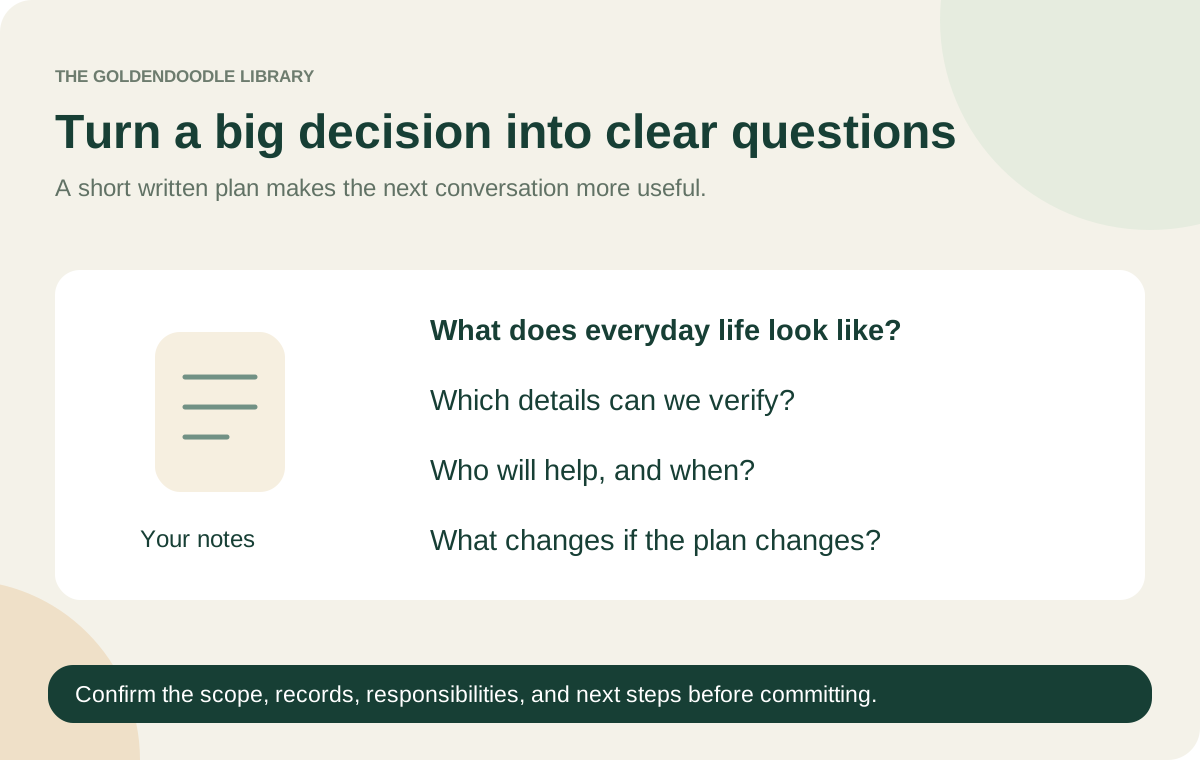
What to remember
Your useful takeaways.
- Ask why these specific parents were paired.
- Request understandable health and identity records for both parents.
- Discuss rearing and matching before choosing by appearance.
- Read the placement and support terms before making a financial commitment.
A little more detail
Explore the questions that matter to you.
Open a section when you want the why behind the short answer.
01Ask about the purpose behind the pairing
Begin with an open question: “What are you hoping this pairing will contribute?” Listen for an explanation that includes the individual dogs rather than only a fashionable generation label or coat color. Ask what the breeder sees as the pairing’s strengths, uncertainties, and practical limits.
If a program describes itself as service-minded, ask how that purpose affects selection and matching. A useful discussion distinguishes breeding goals from completed training credentials and from the future suitability of a puppy. No ancestry story should eliminate the need to evaluate the individual dog as it develops.
02Make records part of the conversation
The Golden Retriever Club of America’s guidance for selecting a breeder emphasizes questions about the sire, dam, close relatives, socialization, and health information. Although written for Golden Retrievers, its question-based approach is useful when evaluating the Golden Retriever ancestry in a Goldendoodle pairing.
Create a short list for each parent: identifying name, relevant screening reports, result dates, and unresolved questions. Ask for clarification if an online database entry, a laboratory report, and a home call name do not obviously line up. A slogan about testing should not replace a document review.
References: [1]
03Ask how daily puppy care supports development
Instead of accepting a long list of impressive-sounding protocols, ask what the puppies actually experience in a normal day and how those experiences are adapted to the individual litter. Ask how handling, visitors, rest, household activity, and early learning are introduced and observed.
The goal is not to collect protocol names. It is to understand how the breeder notices when a puppy is comfortable, how concerns are recorded, and what information is passed to the next family. A puppy who is overwhelmed during a demonstration is not proving readiness by merely staying present.
04Describe your household honestly
A matching conversation works best when the family is specific about daily routines. Include work schedules, available support, children’s needs, other animals, handling limitations, grooming plans, and the settings the dog will be expected to navigate. A breeder cannot help match around information the family leaves out.
Ask how observations are collected and how puppy preferences are balanced with household suitability. If the breeder suggests waiting or considering another puppy, ask for the reasoning. You should be able to understand the recommendation without being pressured to accept a match that does not feel manageable.
05Understand the agreement and the continuing relationship
Before making a financial commitment, read the written terms for reservations, timing, health-related provisions, returns, and ownership responsibilities. Ask what lifetime support means in practice: how to make contact, what topics the breeder can help with, and when veterinary or training professionals should be involved.
Keep copies of explanations that materially affect your decision, including what is estimated about adult size, coat, and future role. A good conversation does not end with a guarantee that nothing will ever go wrong. It ends with clear responsibilities and a plan for communicating if circumstances change.
- Why these parents, and what would make you decide against the pairing?
- What records may I review before reserving?
- How do you observe development and decide on matches?
- What are the limits of coat, size, and service-potential estimates?
- What happens if the family or dog needs additional help later?
Sources & further reading
References supporting this guide; inclusion does not imply endorsement of our program.
For an individual dog’s health or behavior, consult your veterinarian or qualified trainer. For access or funding questions, check current official guidance.
A personal next step
Talk it through with Blaine.
Ask about a planned pairing, puppy matching, or preparing for home.