The short version
Three things to keep in mind.
- 01
Ask which screening fits both parent breeds.
- 02
Read results instead of relying on a badge.
- 03
Discuss abnormal, incomplete, or follow-up findings.
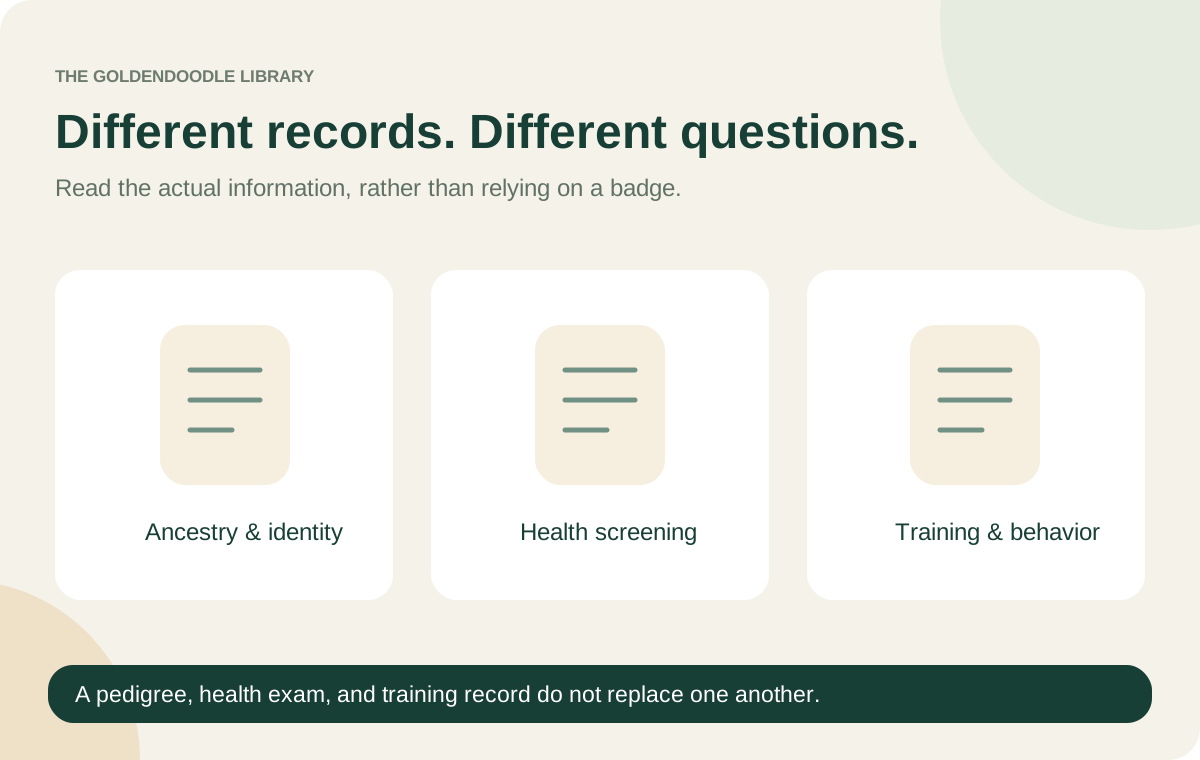
What to remember
Your useful takeaways.
- DNA results and clinical screening exams answer different questions.
- Ask about recommendations relevant to both parent breeds and the particular dogs.
- A CHIC number does not mean every result is normal.
- No screening program eliminates every health risk or replaces ongoing veterinary care.
A little more detail
Explore the questions that matter to you.
Open a section when you want the why behind the short answer.
01Ask which kinds of screening were performed
GRCA’s breeding guidance addresses hip, elbow, eye, and cardiac evaluation. Poodle Club of America recommendations vary with Poodle variety and include both DNA and examination-based screening. A Goldendoodle discussion should therefore consider the ancestry and circumstances of both parents rather than borrowing one convenient test list.
Ask a veterinarian familiar with breeding health to help interpret the relevant recommendations. The correct response to a complicated result is not to select the most reassuring word on a report. It is to understand the condition, the test, the dog’s identity and age at testing, and the relevance to the proposed pairing.
02Why a DNA panel is not the whole picture
A DNA test looks for specified variants under the laboratory’s stated interpretation. It does not inspect every possible cause of disease. The ACVO’s discussion of genetic testing explains why a normal DNA result does not replace the broader information provided by an eye examination.
For a practical comparison, imagine a report listing hundreds of genetic markers but no explanation of orthopedic or eye screening. The size of the panel does not fill those gaps. Ask which additional evaluations are appropriate, and do not assume the phrase “clear on everything” refers to every disease a dog could ever develop.
References: [3]
03Read the record, not only the badge
OFA’s CHIC number indicates that the required breed-specific screening results were completed and made public under that program’s rules; it does not imply that every result was normal. Requirements can change, so the underlying report and its timing are important.
Check that the report belongs to the named parent and that you can identify the test, result, date, and any relevant examiner or laboratory. If information cannot be located, ask the breeder for clarification. Lack of an online match is a reason to investigate, not a reason to invent either a favorable or an unfavorable result.
References: [4]
04Put results into the family and pairing context
An individual result is more useful when the breeder can explain how it informs the pairing. Ask what is known about close relatives, what concerns have occurred in the family, and what trade-offs were considered. Healthy appearance on the day of a visit cannot supply that history.
For a genetic carrier result, avoid assuming that one unfamiliar word tells the whole story. The meaning depends on the condition and its inheritance. Ask for professional interpretation of the proposed pairing rather than treating every carrier result as a sick dog or every clear result as an ideal breeding decision.
05A record-review checklist for families
Request the records early enough to review them without pressure from a reservation deadline. If necessary, pay for independent veterinary advice before committing to a placement. Screening is one part of responsible selection alongside temperament, structure, rearing, transparency, and a plan for the dog’s lifetime.
Keep your questions specific and respectful. A useful discussion should leave you with documents you understand and a realistic explanation of uncertainty, rather than the impression that any breeder can guarantee a dog will never need treatment.
- What recommendations are relevant to each parent’s breed background and variety?
- Which results can I inspect for both parents?
- Were any findings abnormal, incomplete, preliminary, or due for follow-up?
- Who can help me understand the implications for this particular pairing?
- What happens if the puppy later develops a health concern?
Sources & further reading
References supporting this guide; inclusion does not imply endorsement of our program.
- Golden Retriever Club of America: Code of ethics and breeding health recommendations ↗
- Poodle Club of America: Health testing recommendations ↗
- American College of Veterinary Ophthalmologists: Role of genetic testing and eye examinations ↗
- Orthopedic Foundation for Animals: CHIC program ↗
For an individual dog’s health or behavior, consult your veterinarian or qualified trainer. For access or funding questions, check current official guidance.
A personal next step
Talk it through with Blaine.
Ask about a planned pairing, puppy matching, or preparing for home.