The short version
Three things to keep in mind.
- 01
Start with a manageable puppy area.
- 02
Repeat a sequence of care, activity, and rest.
- 03
Transfer records and arrange veterinary follow-up.
What to remember
Your useful takeaways.
- Start with a small, prepared living area and a predictable sequence of activities.
- Arrange veterinary follow-up and transfer the puppy’s records promptly.
- Keep introductions calm and build responsibility into the family calendar.
- Track patterns instead of expecting a perfect first night.
A little more detail
Explore the questions that matter to you.
Open a section when you want the why behind the short answer.
01Make arrival quiet and practical
Before collection, ask what the puppy currently eats, how meals are measured, what rest arrangements they know, and what records will accompany them. Arrange the first veterinary visit and ask that team how to handle local infection risks. Keep the initial home area manageable rather than opening every room at once.
AAHA emphasizes supervision, a prepared environment, and adapting early care to the household. Visitors can wait. On arrival, show the planned toilet location and then offer a quiet chance to investigate the prepared area. The puppy does not need a full tour, a bath, and a string of introductions on the first afternoon.
References: [1]
02Build a sequence you can repeat
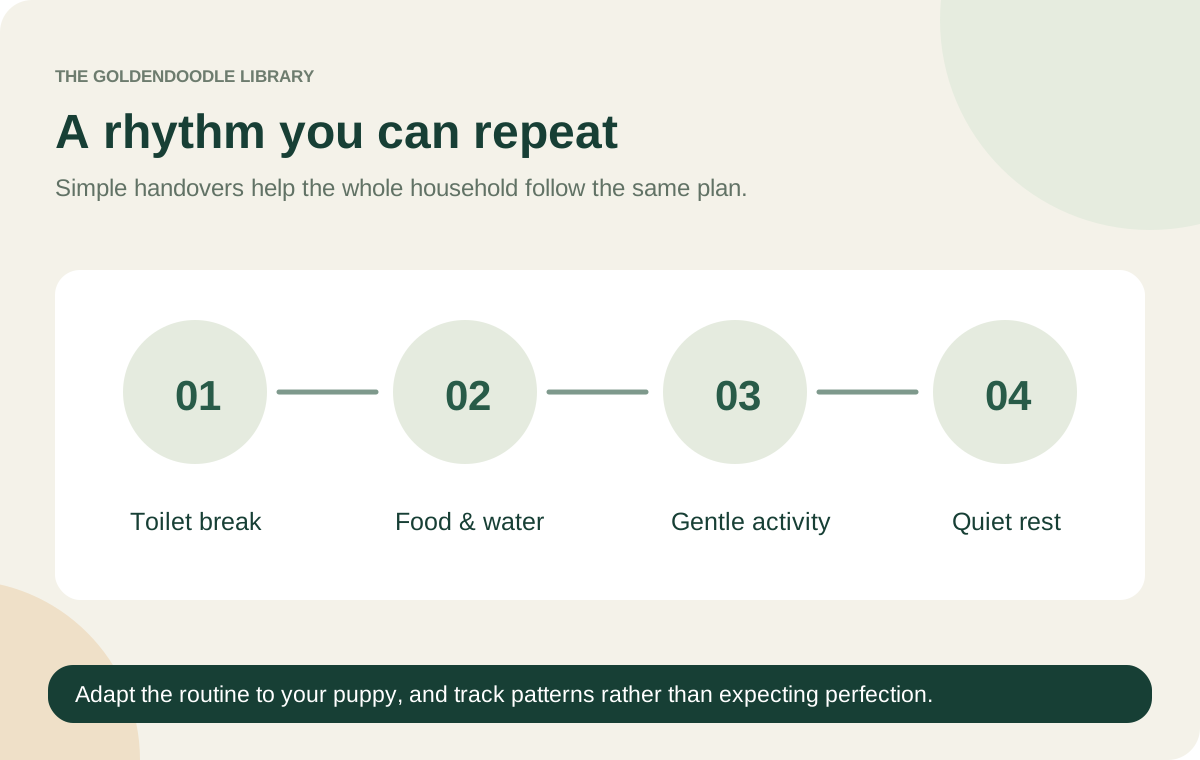
VCA recommends a daily routine that meets a puppy’s needs for feeding, activity, training, elimination, and sleep. Think in sequences rather than a rigid clock: wake, toilet opportunity, meal or brief activity, another toilet opportunity, then rest. A puppy’s needs will change with age and individual development.
Here is a planning exercise: write down who handles the early outing, meals, midday supervision, evening activity, and overnight interruptions. If everyone assumes someone else is watching the puppy, supervision gaps are almost inevitable. Put supplies near the relevant doorway so the routine is easy when you are tired.
References: [2]
03Make family handovers explicit
Use a shared note with four headings: last meal, last toilet opportunity, last rest period, and anything unusual. The note need not be elaborate. “Ate usual meal, toileted outside, resting now” is more useful to the next caregiver than “doing fine.” Add questions for your next conversation with the breeder or veterinary team.
Choose a small set of household words together. If one person says “bed,” another says “place,” and another physically moves the puppy, your plan becomes difficult to maintain. Decide what you want to practice and where. Pick a few achievable priorities for the week; a perfect sit is less urgent than an understandable daily rhythm.
| Handover note | Example entry |
|---|---|
| Food | Usual meal offered; record what was eaten |
| Toilet | Location and result of most recent opportunity |
| Rest | Currently asleep in the agreed area |
| Question | What should the next caregiver watch for? |
04Review the week without grading the puppy
At the end of each day, ask which part of the setup was easiest and which required too much last-minute improvisation. If evenings are chaotic, try making the room quieter and simplifying the activity plan. If toilet opportunities are frequently missed during handovers, change the reminder system rather than blaming one person.
Record appetite, drinking, toileting, comfort, and behavior changes for your veterinary team. Contact them promptly about concerning symptoms or a puppy who seems unwell; an online routine cannot establish what is normal for an individual dog. For ordinary planning questions, bring your notes to the breeder or trainer so the next adjustment addresses a specific pattern.
Sources & further reading
References supporting this guide; inclusion does not imply endorsement of our program.
For an individual dog’s health or behavior, consult your veterinarian or qualified trainer. For access or funding questions, check current official guidance.
A personal next step
Talk it through with Blaine.
Ask about a planned pairing, puppy matching, or preparing for home.