
The short version
Three things to keep in mind.
- 01
Speak with your allergist before committing.
- 02
Keep shedding claims separate from allergy claims.
- 03
Agree on a practical plan if tolerance changes.
What to remember
Your useful takeaways.
- No dog breed is reliably free of allergens for every allergic person.
- Less shedding and lower allergy risk are different claims.
- A short visit cannot guarantee long-term tolerance.
- Make an allergy plan before a deposit or placement, with professional medical guidance.
A little more detail
Explore the questions that matter to you.
Open a section when you want the why behind the short answer.
01Why the coat alone cannot answer the question
The American Academy of Allergy, Asthma & Immunology explains that animal allergens include proteins associated with dander, saliva, and urine, and states that there are no truly hypoallergenic dog breeds. Fur can also carry material such as outdoor allergens. A tidy-looking coat therefore does not establish medical compatibility.
This changes the question to ask a breeder. Instead of “Is this generation allergy safe?”, ask the breeder to describe the limits of any allergy-related claim. They can explain the puppy’s parentage and observed coat qualities, but they should not diagnose a family member or promise that medical symptoms will not occur.
References: [1]
02Keep coat predictions separate from medical decisions
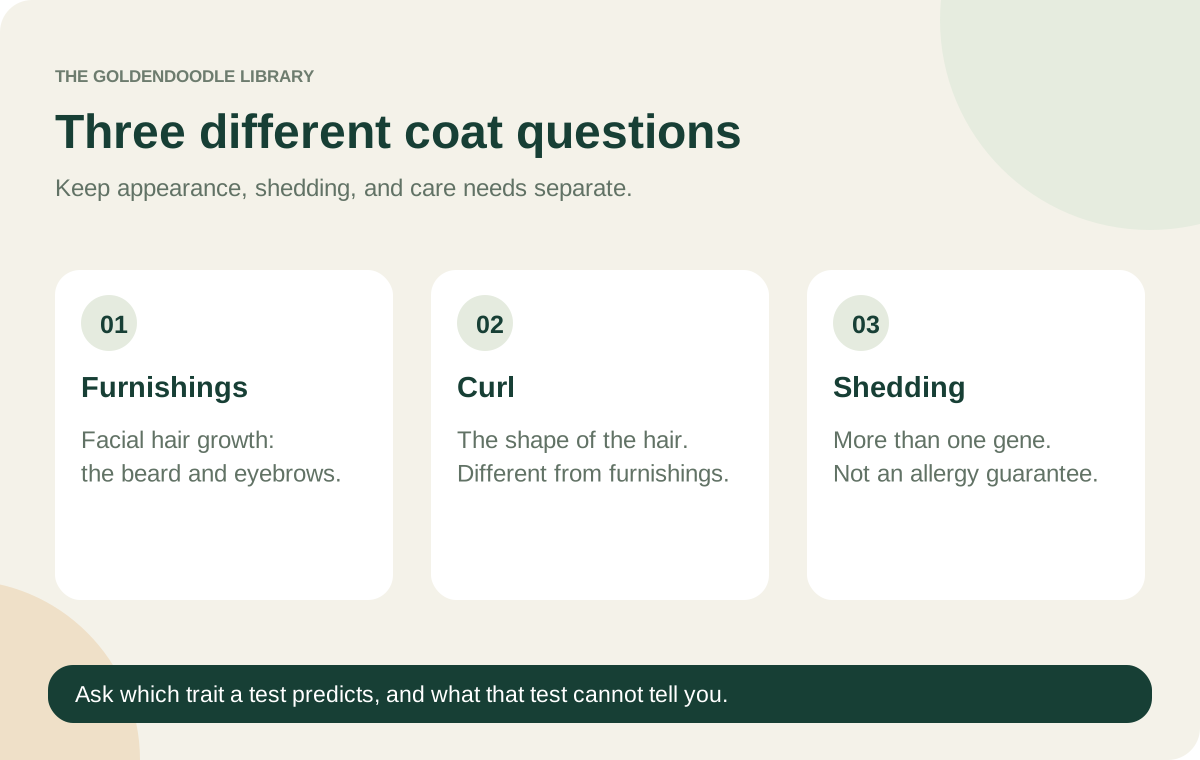
A laboratory shedding result addresses a coat-related genetic question. It is not a human allergy test. If you are interested in low-shedding traits for cleaning convenience, that is a reasonable topic to discuss, but it should remain separate from the question of whether a particular person can safely live with a dog.
Write down who in the home has symptoms, whether symptoms have been professionally assessed, and which unanswered questions need medical input. Include regular visitors and caregivers when they are part of everyday household life. A clear plan is more useful than a broad assurance that a coat “usually works.”
References: [2]
03Prepare for the allergist conversation
Take your actual situation to the clinician: the person’s symptom history, any breathing concerns, the intended living arrangements, and the hope of adding a dog. Ask which evaluations and exposure decisions are appropriate for that individual. Do not change medications or deliberately test tolerance through a challenge without professional advice.
You can also ask what a household would need to do if a dog is introduced, how symptoms should be monitored, and what signs would mean the plan needs to change. Those decisions belong with the person’s medical team. A breeder can support a careful timetable without becoming the source of medical clearance.
References: [1]
04What a visit can and cannot do
A visit can help you meet the breeder and observe the dogs. It cannot prove how someone will feel after living with a growing dog for months. A puppy’s future routine, the amount of contact, and the circumstances of exposure will not be identical to a short appointment.
Before arranging a meeting, explain the allergy concern and ask what kind of visit is possible without placing either the visitor or the dogs under avoidable stress. Keep the purpose modest: gathering information within a medically appropriate plan, not earning a lifetime “passed” result for the puppy.
05Agree on the practical plan before commitment
Read the written placement and return terms before a deposit. Ask how the breeder handles a situation in which a placement cannot continue, what support is available, and what responsibilities the family retains. The goal is to avoid making urgent decisions when a family member is unwell and the household is already attached to the puppy.
Do not let time pressure replace preparation. It is reasonable to pause, get professional advice, and return to the puppy conversation later. The best match is one the family can manage safely and responsibly, with honest expectations about both the human needs and the dog’s long-term care.
Sources & further reading
References supporting this guide; inclusion does not imply endorsement of our program.
- American Academy of Allergy, Asthma & Immunology: Pet allergy ↗
- UC Davis Veterinary Genetics Laboratory: Shedding+ ↗
For an individual dog’s health or behavior, consult your veterinarian or qualified trainer. For access or funding questions, check current official guidance.
A personal next step
Talk it through with Blaine.
Ask about a planned pairing, puppy matching, or preparing for home.