The short version
Three things to keep in mind.
- 01
Ask your vet about suitable growing-dog activity.
- 02
Mix movement with sniffing, learning, and rest.
- 03
Adjust difficulty when the puppy struggles.
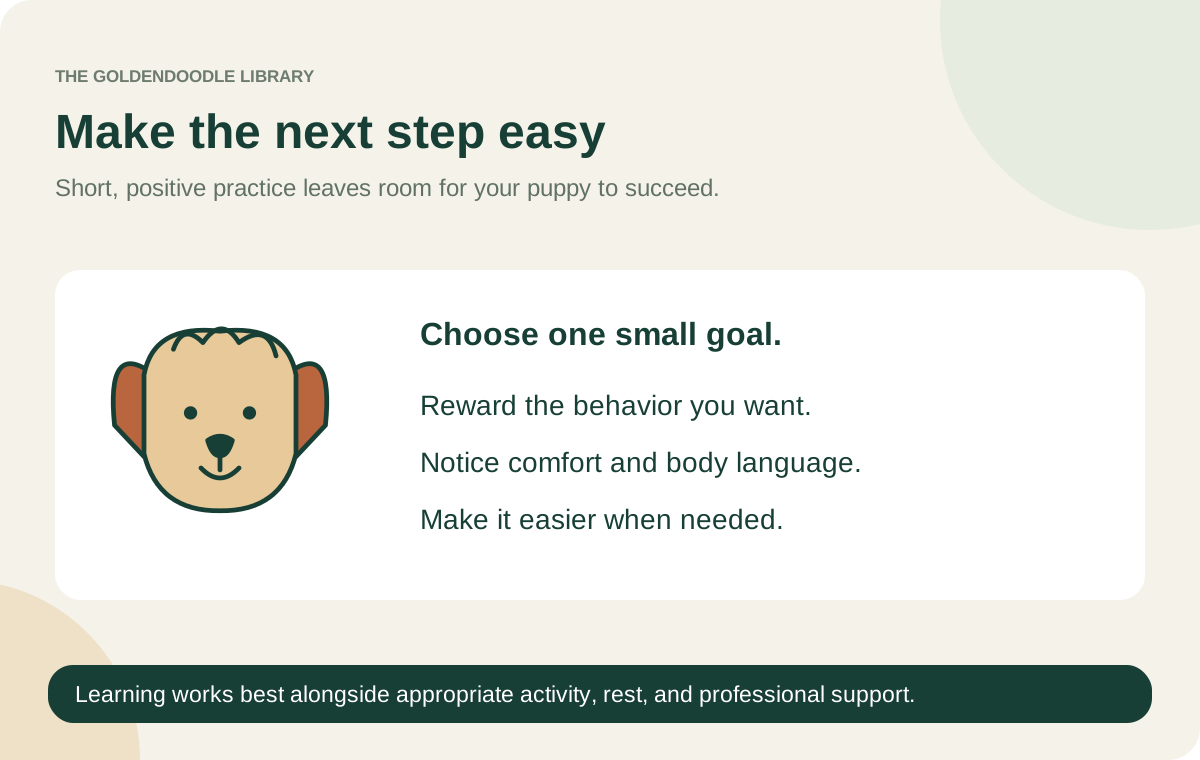
What to remember
Your useful takeaways.
- Ask your veterinarian about activity suited to growth and health.
- Offer choices and manageable challenges rather than constant intensity.
- Count food used in enrichment as part of the feeding plan.
- Watch the dog’s response and adjust the activity, not only its duration.
A little more detail
Explore the questions that matter to you.
Open a section when you want the why behind the short answer.
01Balance different kinds of activity
VCA describes physical, social, and cognitive enrichment as ways to support a dog’s daily life. Short learning opportunities, sniffing, and manageable problem-solving can be part of the plan. Organized sports or more demanding activity should be discussed with a veterinarian to establish whether they are appropriate for that dog.
Do not assume every busy or mouthy moment means the puppy needs harder exercise. Review the whole day: opportunities to toilet, comfort, rest, social contact, and the difficulty of activities. A plan that alternates manageable activity with a quiet period gives you better information than trying to exhaust the puppy whenever the household becomes busy.
References: [1]
02Choose enrichment that the dog can actually use
VCA advises adjusting the difficulty of activity toys and considering the individual dog’s preferences. Start with something easy enough that the dog can succeed. A puzzle that repeatedly frustrates the puppy is not automatically a better learning opportunity because its packaging calls it advanced.
Supervise new items, check their condition, and account for the food they contain. Some dogs enjoy sniffing and searching more than a particular purchased puzzle. If an activity suddenly becomes uncomfortable or the dog avoids using the mouth or neck as usual, speak with your veterinarian instead of simply increasing the value of the food.
References: [2]
04Use observation to refine the plan
AAHA recommends discussing puppy exercise and safe occupation with the veterinary team. Ask about the surfaces, duration, intensity, and types of activity you have in mind, especially before adding repetitive running, jumping, or an organized sport. A general article cannot clear a particular growing dog for those activities.
Keep notes about comfort during and after activities, enthusiasm, recovery, and any unusual signs. Bring lameness, pain, unexpected tiredness, or other concerns to your veterinarian. For ordinary scheduling questions, change one part of the routine at a time and observe. The aim is a healthy, satisfying life for the dog, not a daily score for distance traveled.
References: [3]
Sources & further reading
References supporting this guide; inclusion does not imply endorsement of our program.
- VCA: Using Predictability, Scheduling, and Enrichment to Train Your Dog ↗
- VCA: Behavior Management — Enrichment and Activity Toys ↗
- AAHA: What should I know about my puppy? ↗
For an individual dog’s health or behavior, consult your veterinarian or qualified trainer. For access or funding questions, check current official guidance.
A personal next step
Talk it through with Blaine.
Ask about a planned pairing, puppy matching, or preparing for home.