The short version
Three things to keep in mind.
- 01
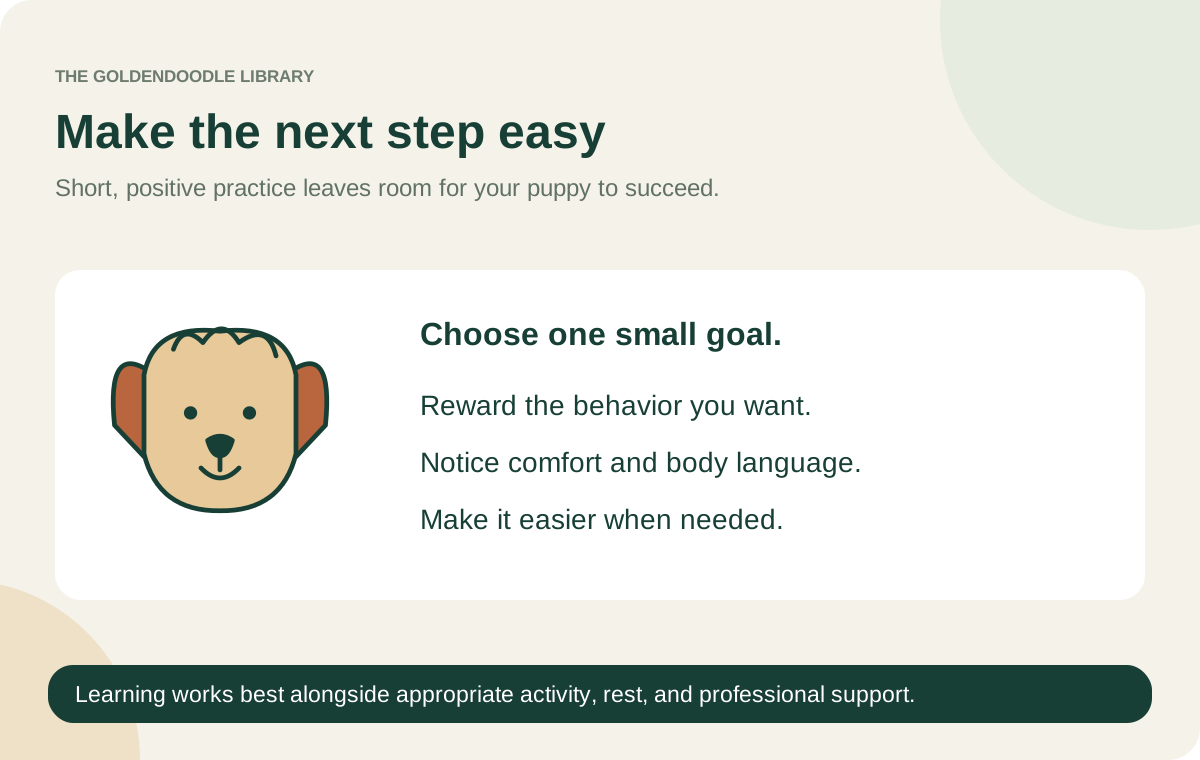
Pick a small, observable skill.
- 02
Reward the behavior you want to see again.
- 03
Adjust the setup when practice gets harder.
What to remember
Your useful takeaways.
- Choose rewards your individual puppy actually values.
- Practice calm skills when the puppy can succeed.
- Teach an alternative behavior instead of relying on repeated corrections.
- Keep a simple record of what makes a session easier or harder.
A little more detail
Explore the questions that matter to you.
Open a section when you want the why behind the short answer.
01Find a reward that works for this puppy
VCA notes that the dog determines what functions as a reward. Food, play, and social attention may have different value in different situations. A puppy leaning away from petting is not necessarily being rewarded by more petting. Notice whether the puppy willingly returns to the activity and remains interested in learning.
Deliver rewards clearly when the useful behavior happens. During early practice, make successful repetitions easy rather than withholding rewards to see how long the puppy will keep trying. Food used in training also belongs in the daily food plan. Ask your veterinary team how to balance rewards with meals if you are unsure about portions.
References: [1]
02Make the practice fit the puppy’s state
VCA recommends teaching quiet skills when a puppy is calmer, rather than expecting a restless puppy to begin with long stillness. Start in a low-distraction space. A brief, successful repetition is useful; repeatedly asking for a behavior the puppy cannot offer adds confusion. Household manners, social experiences, and toilet routines are also learning.
For settling practice, choose a comfortable mat near you. Begin by noticing and rewarding easy moments of staying on or near it. You can build duration, distance, and distractions separately. If the puppy leaves, consider whether the step was too difficult or whether another need was unmet, then make the next attempt easier.
References: [2]
03Try a clear household rehearsal
Imagine your goal is preparing breakfast while the puppy rests nearby. First rehearse when no one is hungry or rushing. Put the mat in a quiet place and organize your supplies. Practice a tiny part of the routine, such as touching the cupboard, then return to the puppy. Write down the point at which the exercise became difficult.
Next time, rehearse less than that amount rather than repeating the whole frustrating sequence. Perhaps the cupboard sound was easy but walking out of sight was too much. This kind of specific observation gives you a useful question for a trainer. “The puppy cannot settle” is broad; “standing up ends every repetition” identifies something you can work on.
04Give the whole household one plan
Create a short instruction card: the behavior you are rewarding, the cue you are using, where you will practice, and how you will end the session. Keep it somewhere caregivers can see it. Agree what to do when you cannot train, such as arranging a safe supervised area instead of repeatedly calling the puppy away from an enticing activity.
Review progress by asking whether the setup helps both you and the puppy. Avoid comparisons with online videos or other dogs. If fear, distress, guarding, or persistent difficulty is part of the picture, involve your veterinarian and a qualified reward-based professional. General household practice is useful, but an individual behavior problem needs a plan tailored to that dog.
Sources & further reading
References supporting this guide; inclusion does not imply endorsement of our program.
For an individual dog’s health or behavior, consult your veterinarian or qualified trainer. For access or funding questions, check current official guidance.
A personal next step
Talk it through with Blaine.
Ask about a planned pairing, puppy matching, or preparing for home.