The short version
Three things to keep in mind.
- 01
Ask your vet about suitable places and classes.
- 02
Keep experiences short and easy to leave.
- 03
Create more space when your puppy needs it.
What to remember
Your useful takeaways.
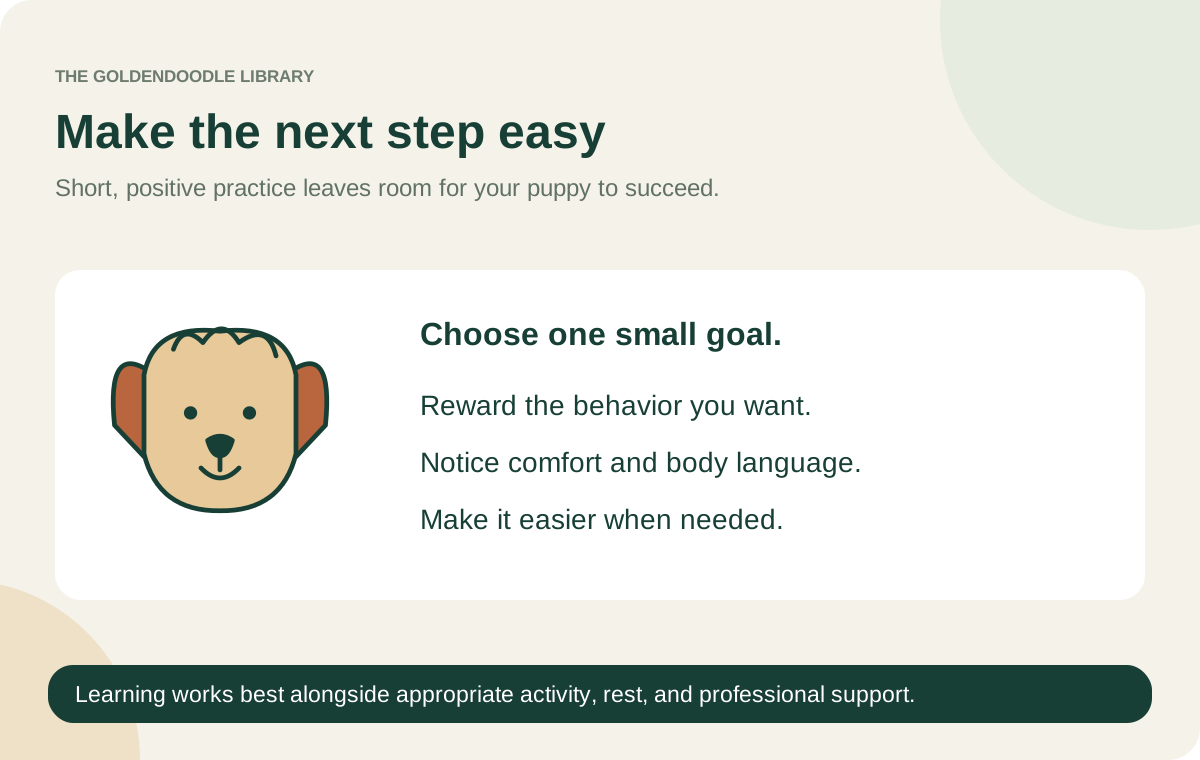
- Ask your veterinarian which settings and classes are appropriate locally.
- Keep experiences short, positive, and easy to leave.
- Observation at a distance can be a successful session.
- Seek help when fear persists rather than forcing closer contact.
A little more detail
Explore the questions that matter to you.
Open a section when you want the why behind the short answer.
01Discuss learning and disease risk together
AVSAB identifies early puppyhood as an important socialization period and supports appropriately managed early experiences. This does not mean ignoring vaccination or disease precautions. Ask your veterinarian about the puppy’s current protection, local risks, and the standards they recommend for puppy classes and contact with other dogs.
Avoid treating “stay home until every vaccine is finished” and “go everywhere immediately” as the only two choices. Your veterinary team can help create options suited to your puppy. A class should have appropriate health requirements, sanitation practices, and a trainer who watches emotional comfort as well as teaching skills.
References: [1]
02Let the puppy’s response set the difficulty
VCA advises beginning new experiences at a comfortable distance and avoiding forced exposure when a puppy is frightened. Look for an ability to investigate, move naturally, and return attention to you. A puppy who repeatedly backs away or appears overwhelmed needs more space, a quieter version of the situation, or an end to the session.
Do not use food to lure a worried puppy into contact they are trying to avoid. A calm observation from farther away can be valuable. If the same concern recurs, ask your veterinarian or a qualified behavior professional for an individualized plan. Fearful behavior deserves useful support, not an assumption that a Goldendoodle should always be outgoing.
References: [2]
03Create a small experience menu
For a planning example, divide a page into sights, sounds, surfaces, people, handling, and transport. Under each heading, list one ordinary experience that fits your real lifestyle. An apartment family might prioritize elevator sounds and hallway activity; a household with mobility equipment may prioritize calm observation around that equipment.
Leave room to record distance, duration, the puppy’s response, and what you would change. “Watched a stroller across the street and then rested” tells you more than checking a “strollers completed” box. Do not try to finish the whole menu in a weekend. Repeating an easy experience can be more useful than collecting a new challenge every outing.
04Ask better questions when choosing a class
Ask how the instructor prevents rough play, whether puppies can observe without joining in, and how the class responds when a puppy wants distance. Ask what vaccination documentation is required and how the space is cleaned. Request an explanation of the training methods before enrollment, not after you discover a method that makes you uncomfortable.
Plan an exit strategy for every outing: where you can step away, who carries supplies, and how you will get home if the puppy has had enough. These practical arrangements make it easier to respect the puppy’s limits. Socialization continues as the dog matures; the aim is a thoughtful habit of learning about the world, not a single completed checklist.
Sources & further reading
References supporting this guide; inclusion does not imply endorsement of our program.
- AVSAB: Puppy Socialization and Humane Dog Training Position Statements ↗
- VCA: Puppy Behavior and Training — Socialization and Fear Prevention ↗
For an individual dog’s health or behavior, consult your veterinarian or qualified trainer. For access or funding questions, check current official guidance.
A personal next step
Talk it through with Blaine.
Ask about a planned pairing, puppy matching, or preparing for home.